 ReactionTimeTests
Peripheral Vision Test
Click the corner that turns green to measure how fast you spot targets at the edge of your vision. Tests peripheral awareness, reaction speed, and target acquisition — the same skills sports stars and FPS pros rely on.
Click any corner to start

What is a Peripheral Vision Test?
A peripheral vision test measures how quickly you can detect a target appearing at the edge of your visual field while focusing on the center. Unlike standard reaction tests where the stimulus appears in front of you, this test forces your eyes to use peripheral retina (the rod-rich outer regions) to spot the signal — then move your cursor to it. It combines wide-field awareness, reaction speed, and aim accuracy into one task.
Most healthy adults have ~180° horizontal visual field. The center 10° is sharp foveal vision; everything beyond is peripheral. Peripheral vision is dominated by rod cells which respond to motion and light changes faster than cone cells but cannot resolve fine detail. That's why a green flash in the corner of your eye is detected before you can identify what it is.
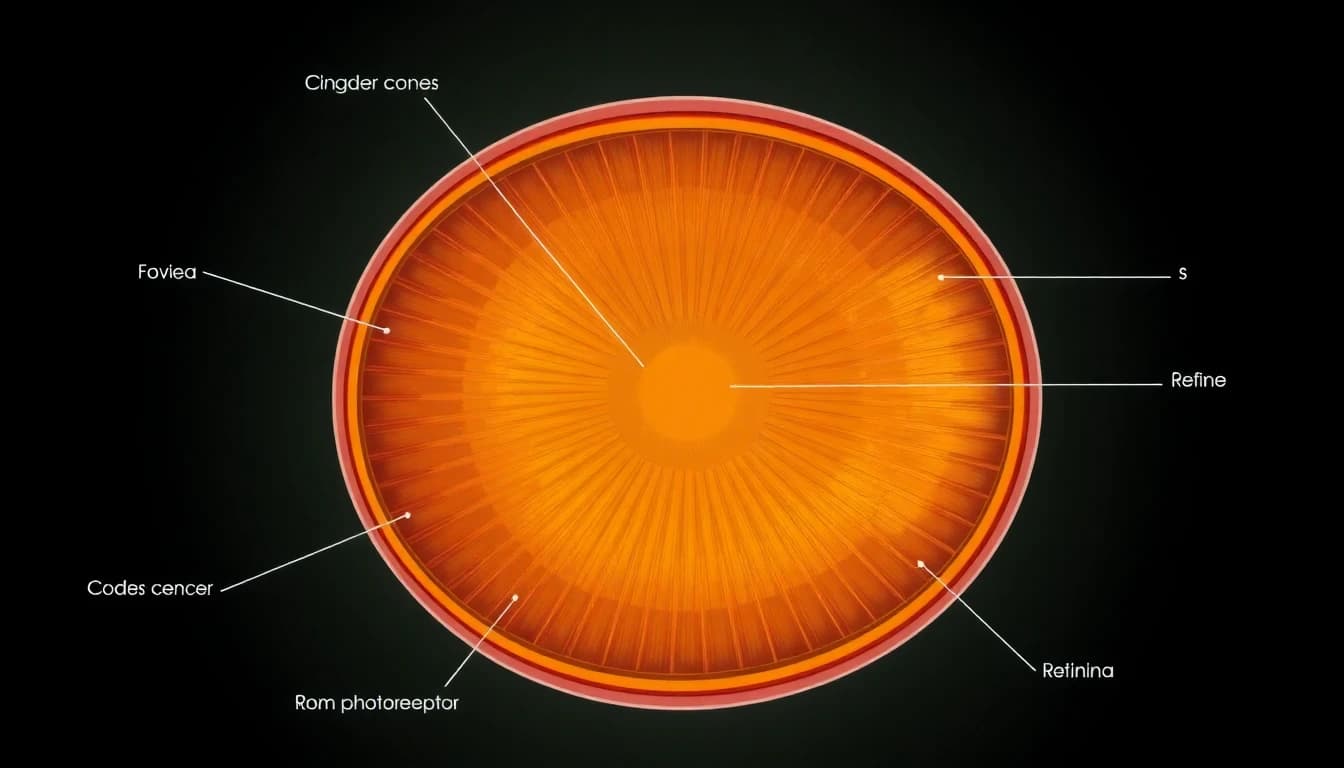
Peripheral vs Center Vision Reaction
Center vision (foveal) reaction is fast for color and detail but limited to a small area. Peripheral vision detects motion and brightness changes across the entire field but with lower resolution. For target acquisition, the bottleneck is usually not detection — it's the eye-to-cursor movement time after detection.
Athletes with elite peripheral vision (NBA point guards, F1 drivers, fighter pilots) measure 100-150ms faster total reaction than average users on tests like this one. The gap comes from peripheral detection plus practiced cursor/eye targeting working together — both trainable skills.
Corner Reaction Time Benchmarks
Peripheral Vision Reaction Time by Age
Peripheral vision narrows with age — the visual field shrinks roughly 1-3° per decade after 40, and reaction time slows alongside. Below are average peripheral vision test scores by age group, including both detection and cursor movement time.
Average Peripheral Vision Reaction Time (ms) by Age
Data based on aggregated test results combining detection time and cursor movement time. Trained athletes consistently score 100-150ms faster than the population averages shown.
Factors That Affect Peripheral Vision Reaction
Mouse Sensitivity
Too low forces large physical movements (slow). Too high makes accurate targeting hard (errors). Find the sweet spot — most pro FPS players use 400-1600 DPI with sensitivity around 1.5-3.0 in-game.
Screen Size and Distance
Larger screens and closer viewing distances expand your peripheral target area, requiring more eye movement. 24-27 inch monitors at arm's length are optimal for this test.
Cursor Starting Position
Centering your cursor before each trial gives equal distance to all 4 corners. Letting it drift adds 50-100ms of variance to your scores.
Age and Visual Field Health
Glaucoma and other conditions silently reduce peripheral field. If your scores are unusually slow at any age, an ophthalmologist visual field test can rule out medical issues.
Lighting and Glare
Strong ambient light reduces peripheral sensitivity. Test in even lighting without screen glare. Window reflections in your peripheral vision add detection delay.
Tracking Practice
Aim trainers (Aim Lab, Kovaak's, Aim Booster) build the same eye-cursor coordination this test measures. 10-15 minutes daily improves scores 50-100ms within weeks.
How to Improve Your Peripheral Vision Reaction
Peripheral vision reaction is one of the most trainable cognitive-motor skills. Most users can shave 100-150ms off their score with focused practice over 4-6 weeks.
Center your cursor before every trial. Equal distance to all four corners means consistent times. Drifting cursor adds 50-100ms variance.
Use peripheral vision actively, not foveal. Resist the urge to look directly at each corner. Your peripheral retina detects the green flash faster than central vision can scan.
Practice with aim trainers. Aim Lab's Spidershot or Kovaak's Tracking scenarios train identical eye-cursor coordination with detailed feedback.
Tune mouse DPI and in-game sensitivity until 360° = 25-35cm of mouse movement. This range is where most pros land for FPS aim.
Anchor your wrist or elbow consistently. Floating arm adds variance. Steady forearm with wrist or finger movement is the proven low-latency technique.
Maintain a 24-27 inch screen at arm's length. This sizes the corner targets to fit just outside your central vision — the sweet spot for peripheral training.
Get an annual visual field exam if scores are unusually slow. Glaucoma, retinitis pigmentosa, and other peripheral-affecting conditions are silent until late stages.
Where Peripheral Vision Reaction Matters
FPS and Esports Gaming
Spotting flanking enemies, watching minimap, and tracking off-screen audio require constant peripheral monitoring. Pro CSGO and Valorant players score 250-350ms on this test.
Driving and Road Safety
Defensive drivers track pedestrians, side traffic, and mirrors using peripheral vision. Reduced peripheral field is a leading cause of older driver crashes — even when central vision tests normal.
Team Sports
Basketball point guards, soccer midfielders, and hockey forwards depend on peripheral vision to read the field. Elite athletes show 30-50% wider effective visual field through training.
Aviation and Emergency Response
Pilots must scan instrument panels and out-of-window peripherally. FAA pilot vision standards include peripheral field requirements measured in the same physical units this test uses.
The Science of Peripheral Vision
The retina has two photoreceptor types: cones (~6 million, packed in the fovea) and rods (~120 million, dominant in the periphery). Rods respond faster to light changes (~10-15ms vs cones' 20-30ms) but lack color discrimination. When a green corner flashes, rod cells detect the brightness change before your visual cortex can identify the color.
Peripheral target acquisition involves three stages: detection (rod activation, ~10-15ms), saccade planning (frontal eye fields, ~100-200ms), and cursor movement (motor execution, ~150-300ms). Total: 260-515ms is normal. Studies including Land & Tatler (2009) on visual attention and Nakayama (1985) on retinal processing speed back these numbers.
Peripheral Vision Test FAQ
Common questions about peripheral vision reaction speed and what your score means.
Under 400ms is good for this test. Average adults score 450-550ms. Pro FPS players and elite athletes consistently hit 250-350ms thanks to trained eye-cursor coordination. Scores under 300ms with high accuracy indicate exceptional peripheral awareness.
Simple click reaction (200-250ms) measures only neural-motor speed. Peripheral vision tests add detection time (rod activation, saccade planning) and cursor movement time. Total is typically 200-300ms slower than simple click reaction tests.
Yes. Aim trainers like Aim Lab and Kovaak's directly train peripheral target acquisition. Most users improve 100-150ms within 4-6 weeks of daily 10-15 minute practice. Sports vision training programs achieve similar results in 6-8 weeks.
Yes. Glaucoma, retinitis pigmentosa, and macular conditions all impact peripheral function. If your scores are consistently very slow despite practice, ask an ophthalmologist for a visual field test (perimetry) — early detection is critical for vision-preserving treatment.
Visual field narrows ~1-3° per decade after age 40. By age 70, peripheral vision is typically 15-20° narrower than at age 25. Reaction time slows alongside. Regular practice and good eye health offset most age-related decline.
Average horizontal visual field is ~180° (combining both eyes), with each eye contributing ~150°. Vertical field is ~135° (~60° up, ~75° down). The central 10° is sharp foveal vision; everything beyond is peripheral, dominated by motion-sensitive rod cells.
Too-low sensitivity forces large physical mouse movements (adds 100-200ms cursor travel time). Too-high sensitivity causes overshooting and corrections (adds error time). Pro FPS players target 25-35cm of mouse movement per 360° in-game turn — same range works for this test.
Aim Lab's Spidershot and Kovaak's Tracking scenarios train the same eye-cursor coordination this test measures. Aim trainers have richer scenarios and analytics, but this test is free, browser-based, and gives quick before/after benchmarks for sessions.
Yes — both biologically (slightly wider effective field) and through trained attention. Studies of NBA point guards, F1 drivers, and tennis players show 30-50% improvement in peripheral target detection compared to non-athletes. The gap is mostly trained, not innate.
Yes. Reduced peripheral field is one of the leading causes of crashes in older drivers, even when central vision tests normal. Most jurisdictions require minimum visual field for licensing. If your scores are unusually slow, get a clinical visual field exam — it's not always something you notice yourself.